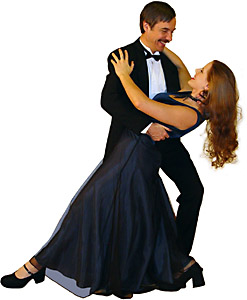


There are many types of dances that fall into the "ballroom dancing" category, and the types that are available include Waltz and Foxtrot, plus several Latin styles that are also considered Ballroom (such as Tango, Cha-Cha, etc.), and the Nightclub Two-Step, which is also often considered a Country style (especially in Colorado).
Waltz is a rather old style of dance, invented in the 1600s, and its music is in 3/4 time. Its name comes from the old German word walzen, which means "to roll, turn, or glide," and these words describe well the smoothness and grace that a well-done waltz exhibits. Born in the suburbs of Vienna and in the alpine region of Austria in the seventeenth century, many of the familiar waltz tunes can be traced back to simple peasant yodeling melodies.
The Dancing Masters of the day saw the Waltz as a serious threat to their profession, because it could be learned easily, whereas the Minuet and other court dances of that era required years of considerable practice, not only to learn the many complex figures, but also to develop suitable postures and deportment. The Waltz was also criticized on moral grounds by those opposed to its closer hold and rapid turning movements. Religious leaders of the 1600s almost unanimously regarded it as vulgar and crude because the gentleman put his hand—get ready for this—on the lady's back!
The Waltz was a fever that quickly spread from Vienna to Germany, France, England, and finally, in 1834, to Boston. It started as a country dance, considered inappropriate for the higher classes, but soon, bored noblemen began slipping down to their servants' quarters to join in the fun. When the English court introduced the new amusement, the editors of the Times of London were aghast and appalled. Indeed, when the Waltz was introduced to the high society of England in 1816, the Times printed the following:
"We remarked with pain that the indecent foreign dance called the Waltz was introduced (we believe for the first time) at the English court on Friday last. . . it is quite sufficient to cast one's eyes on the voluptuous intertwining of the limbs and close compressor on the bodies in their dance, to see that it is indeed far removed from the modest reserve which has hitherto been considered distinctive of English females. . . now that it is attempted to be forced on the respectable classes of society by the civil examples of their superiors, we feel it a duty to warn every parent against exposing his daughter to so fatal a contagion."
To realize where the editors of the Times were coming from, you have to consider the "proper" dances of the period: Minuet, Contra Dance, and Allemande. They were danced at arms' length, in stiff and upright position, and dancers even wore gloves to avoid any contact with each other!
As the waltz continued to spread, it began to be accepted in society. The composers of the waltz tunes were partly to blame for the changed attitudes. . . their music was wonderful! The triple-beat pattern prompted graceful gliding, rising and falling with the pulse. By 1900, a typical dance program was 75% Waltzes, and only 25% all other dance types combined. To this day, Waltz remains a popular ballroom dance.
As you can see below, quite a few Waltz moves have counterparts in Foxtrot. These moves are not identical, of course, because Waltz uses 3/4 music and Foxtrot uses 4/4 music, but if you are familiar the Waltz version of a shared move, you'll easily pick up the Foxtrot version, and vice versa. Below is what is typically taught in a Level 1 Waltz class (if there is time; if not, the more complex moves would be taught in a Level 2 class):
|
The Foxtrot originated in the summer of 1914 by Vaudeville actor Harry Fox. Born Arthur Carringford in Pomona, California, in 1882, he adopted the stage name of "Fox" after his grandfather.
In early 1914, Fox was appearing in various vaudeville shows in the New York area. In April he teamed up with Yansci Dolly of the famous Dolly Sisters in an act of Hammerstein's. At the same time, the New York Theatre, one of the largest in the world, was being converted into a movie house. As an extra attraction, the theater's management decided to try vaudeville acts between the shows. They selected Harry Fox and his company of "American Beauties" to put on a dancing act. An article in Variety Magazine stated "Harry Fox will appear for a month or longer at a large salary with billing that will occupy the front of the theatre in electrics."
At the same time, the roof of the theatre was converted to a "Jardin de Danse" ("Dance Garden"), and the Foxtrot originated there. As part of his act downstairs, Harry Fox was doing trotting steps to ragtime music, and people referred to his dance as "Fox's Trot."
The Foxtrot has been called the most significant development in all of ballroom dancing. The combination of quick and slow steps permits more flexibility and gives much greater dancing pleasure than the one-step and two-step, which it largely replaced. Part of Foxtrot's versatility—and the source of some of the trickiness in learning it—is the fact that Foxtrot has some 6-count moves and some 8-count moves, even though the music is in eights. Correct transitioning between these two lengths of moves can be an adventure!
Since Foxtrot includes both 6-count steps and 8-count steps, which kind should you learn first? If you learn the 6-count steps first (commonly done), it will train you to not pay attention to the downbeat of the music—which is 8-count music—because you are rarely in sync with the musical measures, and that is a disservice to the student in the long run. On the other hand, if you learn the 8-count steps first, it trains you to pay attention to the music, because you are always in sync with the 8-count measures. Then, once you've developed a solid habit of hearing where the downbeats are, you'll be able to do the 6-count steps, and know when to come back to the 8-count steps; i.e., you'll still be dancing in sync with the music (which always looks better).
As you can see below, quite a few Foxtrot moves have counterparts in Waltz. These moves are not identical, of course, because Waltz uses 3/4 music and Foxtrot uses 4/4 music, but if you are familiar the Foxtrot version of a shared move, you'll easily pick up the Waltz version, and vice versa. Below is what is typically taught in a Level 1 Foxtrot class (if there is time; if not, the more complex moves would be taught in a Level 2 class):
|
The Peabody is a ballroom dance that was invented in 1915 and gained popularity in the early 20th century. Originally a fast variation of the Foxtrot, the Peabody was (according to the legends that are probably true) named after its inventor, Lieutenant William Frank Peabody of the NYPD, an active dancer and a particularly rotund gentleman. One attribute of this dance is its common use of the Outside Partner positions, both left and right. This came about as a very natural result of the fact that Lt. Peabody was so fat ("a man of considerable girth"), that he had to keep the lady to the side much of the time, because there simply wasn't room for her in front of his belly.
The music typically used for Peabody is quite fast, the most common types being Ragtime, Dixieland, and other comparable Flapper-style music.
Below is what is typically taught in a Level 1 Peabody class:
|
Swing dancers might be surprised to see the Charleston categorized as a Ballroom style instead of a Swing style. The reason for this is that the Charleston underwent a dramatic change between the 1910s-1920s and the 1940s, and the style of Charleston referred to here is the 1920s style. The 1910s and 1920s was when it first gained widespread popularity, and the dance was more upright and of a "hoppy" style; think of Shirley Temple and Flappers. In contrast, the 1940s style was lower (knees more bent) and was of a more "running" style; think of Frankie Manning and Whitey's Lindy Hoppers.
The music typically used for 1920s Charleston is the same as that used for Peabody: Ragtime, Dixieland, and comparable Flapper-style music. For that reason, the 1920s-style Charleston was often done in conjunction with the Peabody (see above).
In the Level 1 1920s Charleston classes, much of the time will be spent working on the mechanics of the steps (which are more tricky than you might expect), and then in Level 2 1920s Charleston classes, we'll get into more lead and follow; actually dancing 1920s Charleston as a couple. Below is what is typically taught in a Level 1 1920s class:
|
The Argentine Tango is a Ballroom dance that is also a Latin dance; see the description on the Latin page.
The Cha-Cha is a Ballroom dance that is also a Latin dance; see the description on the Latin page.
Some people and dance organizations consider the Salsa to be a Ballroom dance. But it is also a Latin dance, so the description is on the Latin page.
Some people and dance organizations consider the Merengue to be a Ballroom dance. But it is also a Latin dance, so the description is on the Latin page.
| No classes currently scheduled. Check back soon for upcoming classes, and don't forget to add your name to DancerGuy's mailing list, so you can be notified via email when classes are getting close! |